GBP/JPY Swing Long — 209.0 to 212.5
Original analysis
English edition of the original analysis by trademvment. Original TradingView publication ↗
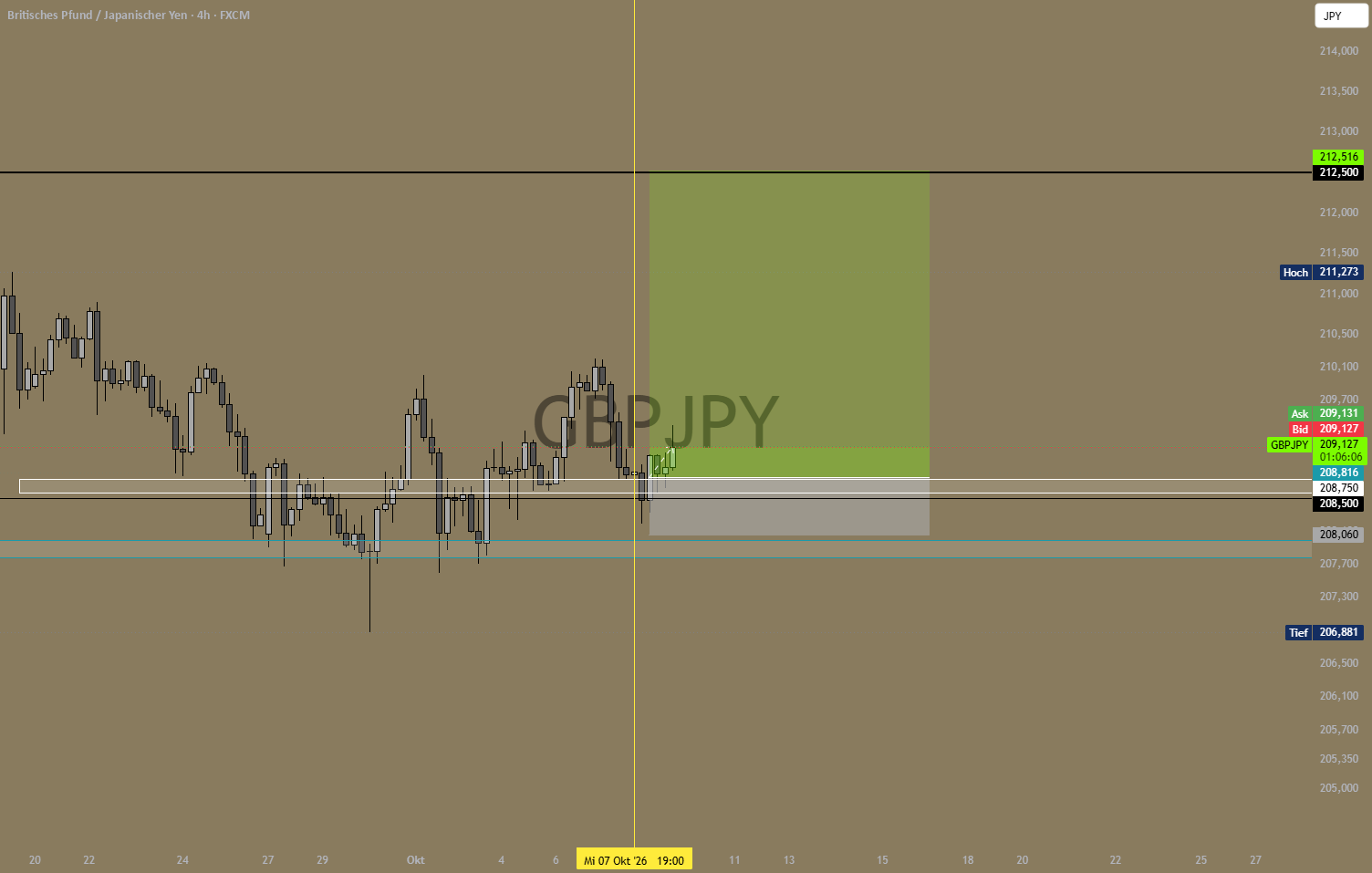
Bias: Long → 212.5 | Focus: October/November 2026
I see an interesting long window in GBP/JPY. My idea combines seasonal recovery potential, differing positioning in the pound and yen, and the predominantly positive UK data surprises recently.
I have already positioned myself near the lower end of the current range. A major breakout in the pound would be a possible additional catalyst; for this trade, a recovery in the pound against a weaker yen is initially enough for me.
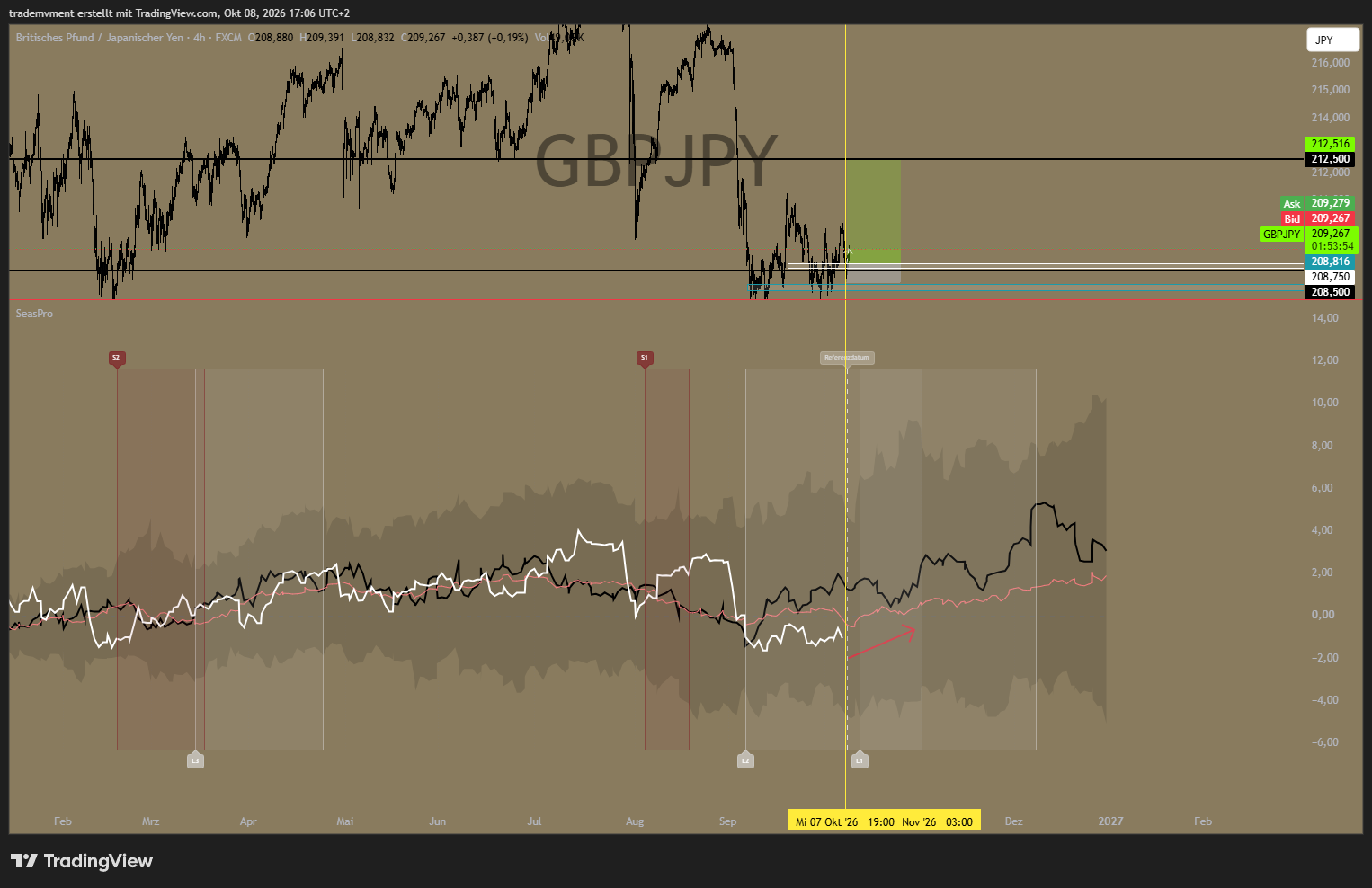
1. Seasonality: A recovery window after the weak late summer
The seasonal evaluation of GBP/JPY shows an interesting recovery window in October/November following the weaker late-summer period. For me, that fits the idea of looking for a long position near the bottom of the range.
However, the paths within October are mixed. I infer a possible recovery phase, rather than an October that rises throughout. What matters to me is the combination of the seasonal window and positioning near the recent lows.
2. The currencies separately: GBP recovery and JPY weakness
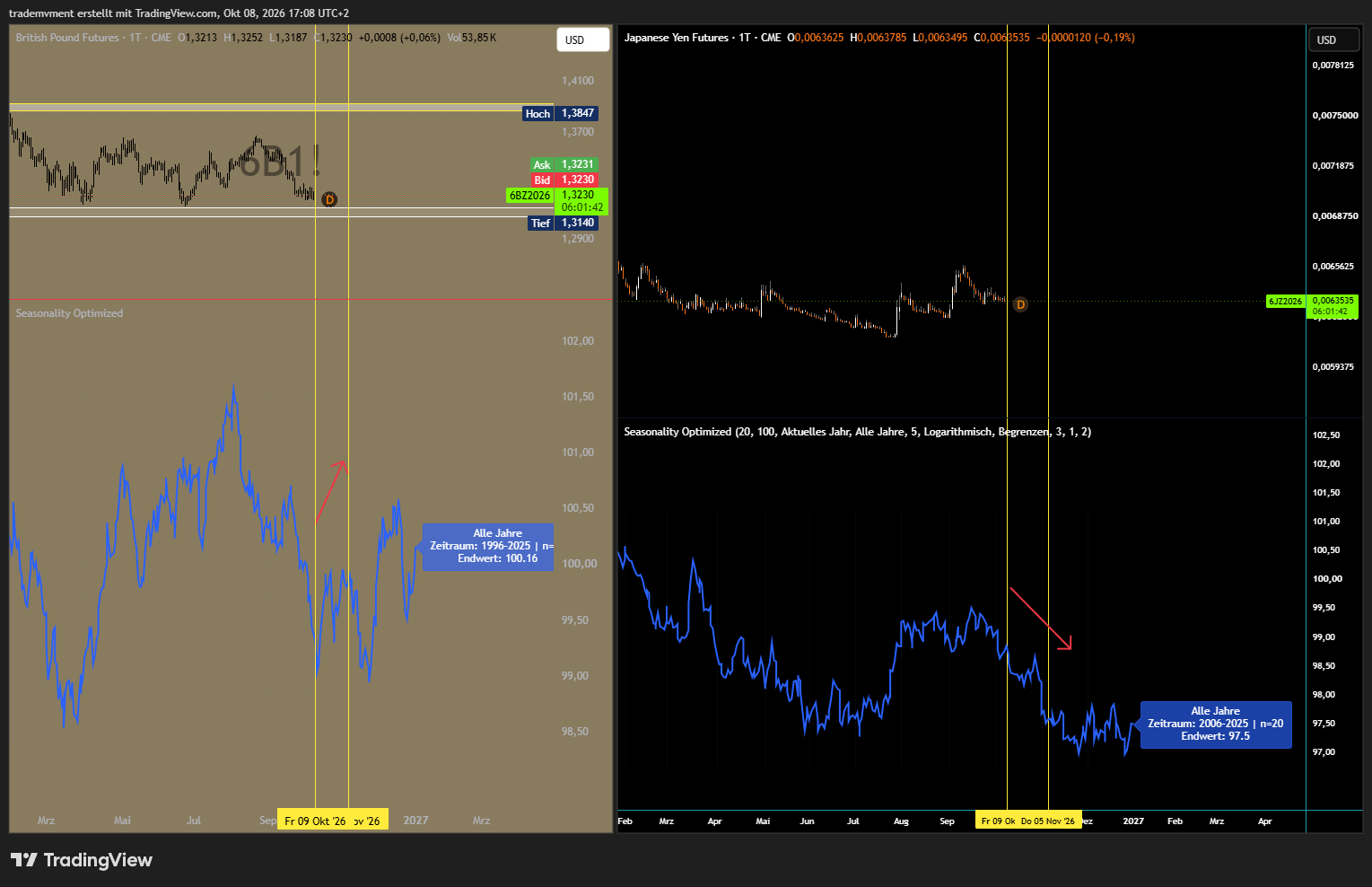
The separate futures evaluations also interest me: In the marked window, I am looking for a seasonal upward countermove in the pound, while the yen's path points more towards further weakness.
The futures are each quoted in US dollars per currency unit. A rising pound future and a falling yen future are therefore broadly consistent with a rising GBP/JPY.
My idea is therefore a relative move: The pound should strengthen against the yen.
3. COT: Different positioning in GBP and JPY
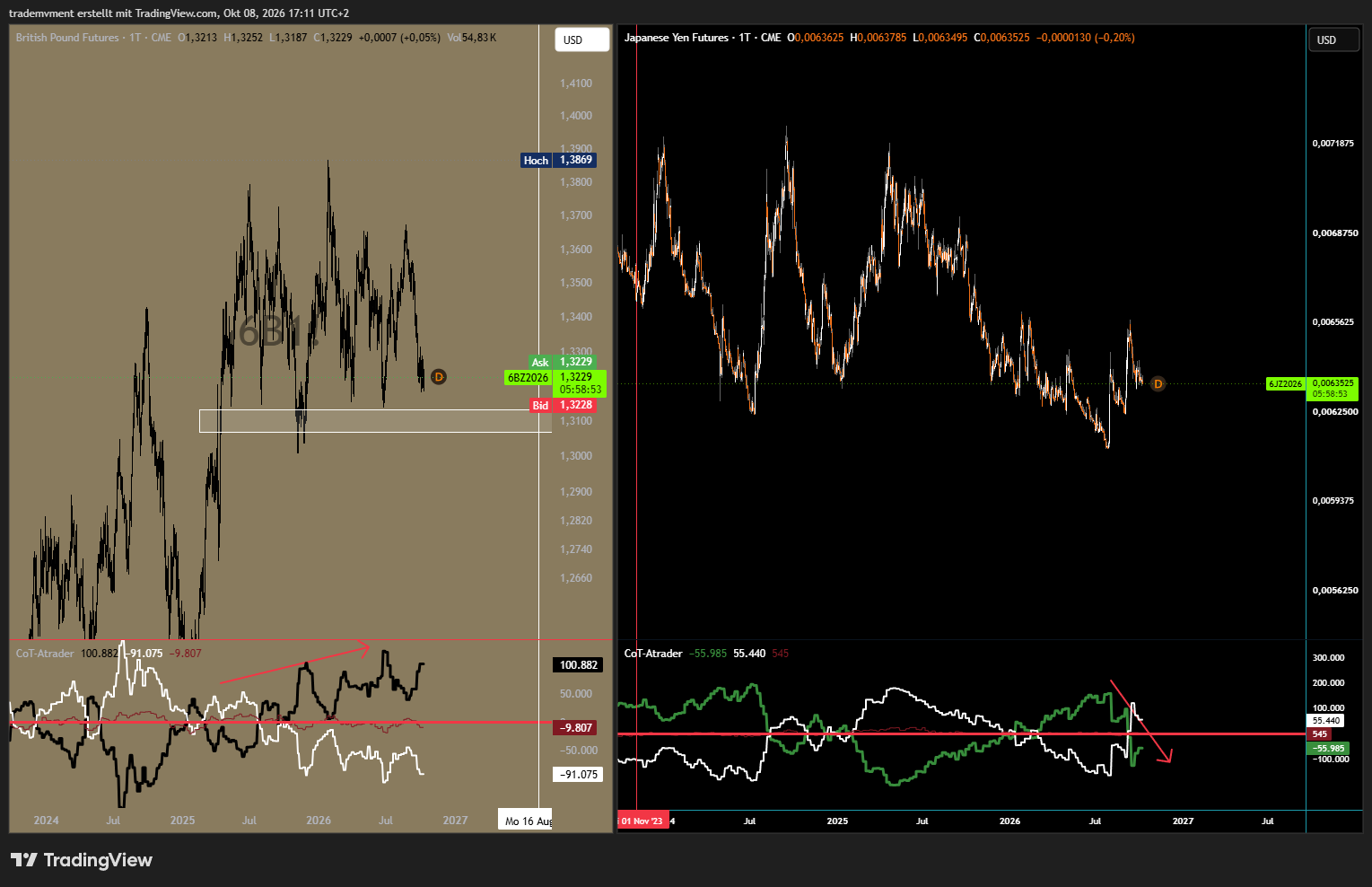
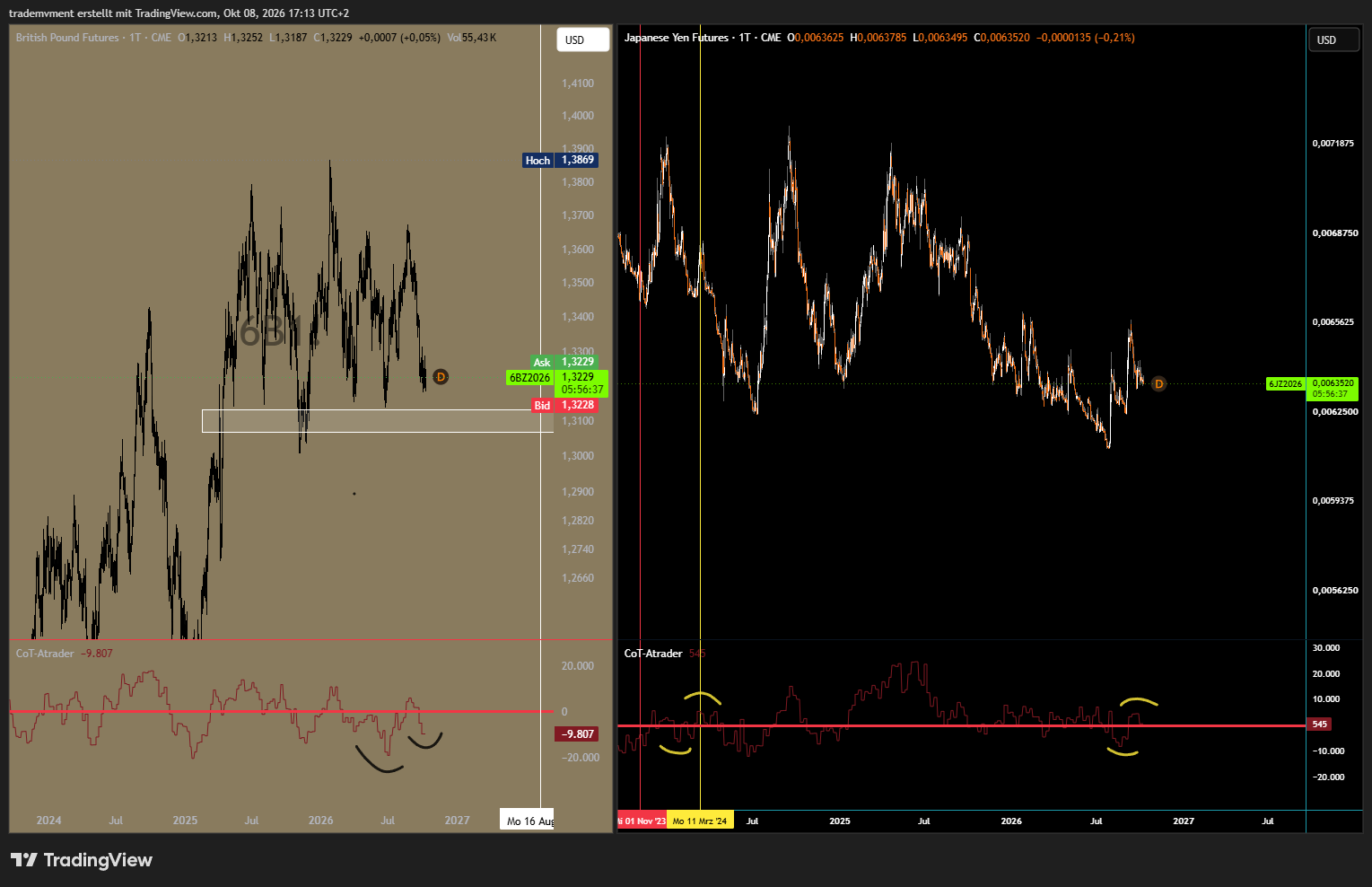
To explain the colours: In the GBP chart on the left, Commercials are black and large speculators are white. For the yen on the right, Commercials are green and large speculators are white. The red line shows Non-Reportables in each case.
GBP: Commercial accumulation while price consolidates
Since last year, Commercials have shifted their net position significantly from negative to positive. As of 29 September, they hold +100,882 contracts net long. Large speculators, by contrast, hold −91,075 contracts net short.
The pound future has largely consolidated since spring 2025. What I find particularly interesting is that the heavy speculative short positioning has so far failed to produce a sustained break of the entire range.
I interpret this resilience, together with Commercial accumulation, as an argument for positioning nearer the lower areas. If prices rise again, short covering could provide additional support. A later breakout above the range highs remains a possibility.
JPY: A pronounced shift in Commercials
The picture is different for the yen. Following the high positive net positioning in summer, Commercials have sharply reduced their net long position and are now −55,985 contracts net short. Large speculators are on the other side at +55,440 contracts net long.
The recent yen recovery has not yet produced a convincing change in the larger downtrend. I read the change in Commercial positioning, together with this price structure, as an argument for further yen weakness.
A retest and potentially a break below the low zone around $0.0060 per yen in the future are therefore part of my scenario.
Commercials hedge business risks. Their net position is therefore not a direct instruction on direction. The opposing net positions of the groups are also mathematically connected. My signal comes from combining positioning, price behaviour and seasonality.
4. Retail comparison: The clearer contrarian signal is in the pound
The Non-Reportables labelled “Retail” in the indicator hold −9,807 contracts net short in the pound. I use this negative positioning as an additional contrarian signal for my long idea.
In the yen, there was recently a rapid shift from approximately −8,000 to around +4,000 contracts temporarily. The latest figure, however, is back near zero at +545 contracts. I therefore do not currently see extreme bullish positioning in this group.
For me, this comparison mainly supports the GBP side. I derive my expectation of further yen weakness more strongly from seasonality and the interaction between COT and price structure.
Non-Reportables are the residual positions calculated outside reportable holdings. This group does not represent a pure retail investor statistic.
5. United Kingdom: Positive surprises and persistent inflation
My UK data overview shows predominantly positive surprises in economic activity and consumption. These include GDP, retail sales, consumer confidence and the listed industrial and trade data. The PMI releases, by contrast, were slightly weaker than expected.
UK GDP grew by 0.4% month on month in July. Retail sales rose by 0.5% in real terms in August. To me, this indicates more resilience than the previously cautious expectations had suggested.
At the same time, annual CPI inflation rose from 2.9% to 3.1% in August and remains above the 2% target. The Bank of England held its policy rate at 3.75% in September; three of the nine members already wanted to raise it to 4.00%.
The labour market remains the weaker side. The data released in September show an unemployment rate of 4.9% for May to July, largely unchanged from the previous three-month period.
My assessment therefore remains: The BoE has reasons to keep rates high for now. Further tightening remains possible if inflation pressure persists. This environment can support the pound.
6. Japan and carry: Relative monetary policy matters
The Japanese data overview shows several negative surprises, including retail sales, industrial production and the trade balance. I am comparing surprise momentum here; this does not imply a general collapse in Japan's economy.
Japan also faces inflation pressure. The Bank of Japan raised its short-term policy rate to around 1.25% in September and signals further increases if the data develop accordingly.
Nevertheless, the UK policy rate is currently 2.50 percentage points higher. For my idea, what matters is how this differential and expectations for future interest rates develop.
I am watching the discussion about an unwinding of yen carry trades. COT data cover futures positions, not all yen-funded transactions worldwide. A broad carry unwind could strengthen the yen and would be a significant headwind for this long trade.
CHF as an additional hypothesis
If expected CHF funding costs were to rise significantly relative to yen funding costs, the yen could become more attractive for new carry financing. Additional yen selling would then be a possible source of pressure.
However, the SNB policy rate currently stands at 0%, below Japan's rate. A small Swiss rate increase alone would therefore not yet make the yen the cheaper alternative. This possible shift remains a secondary hypothesis for me.
7. My GBP/JPY scenario
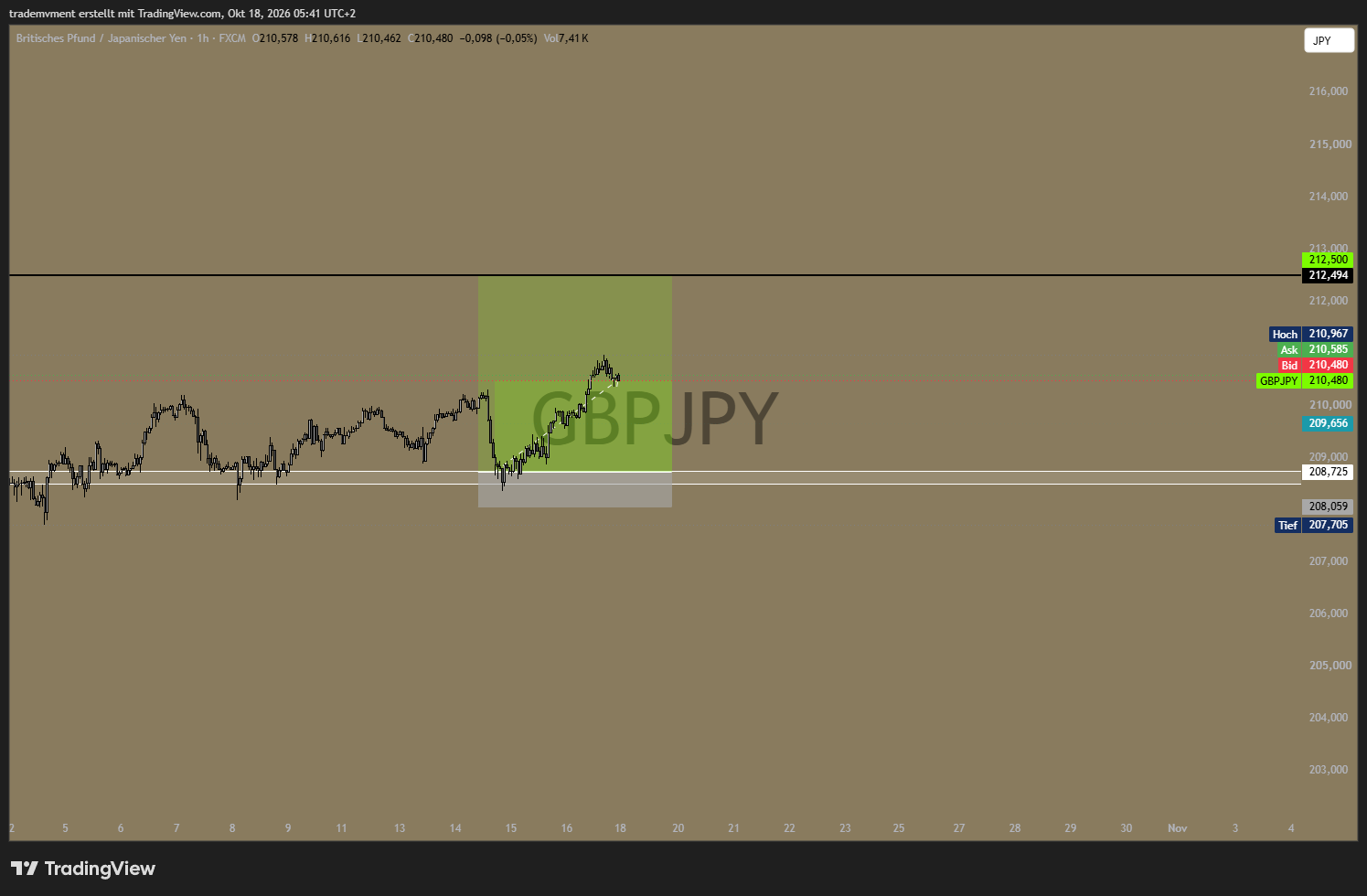
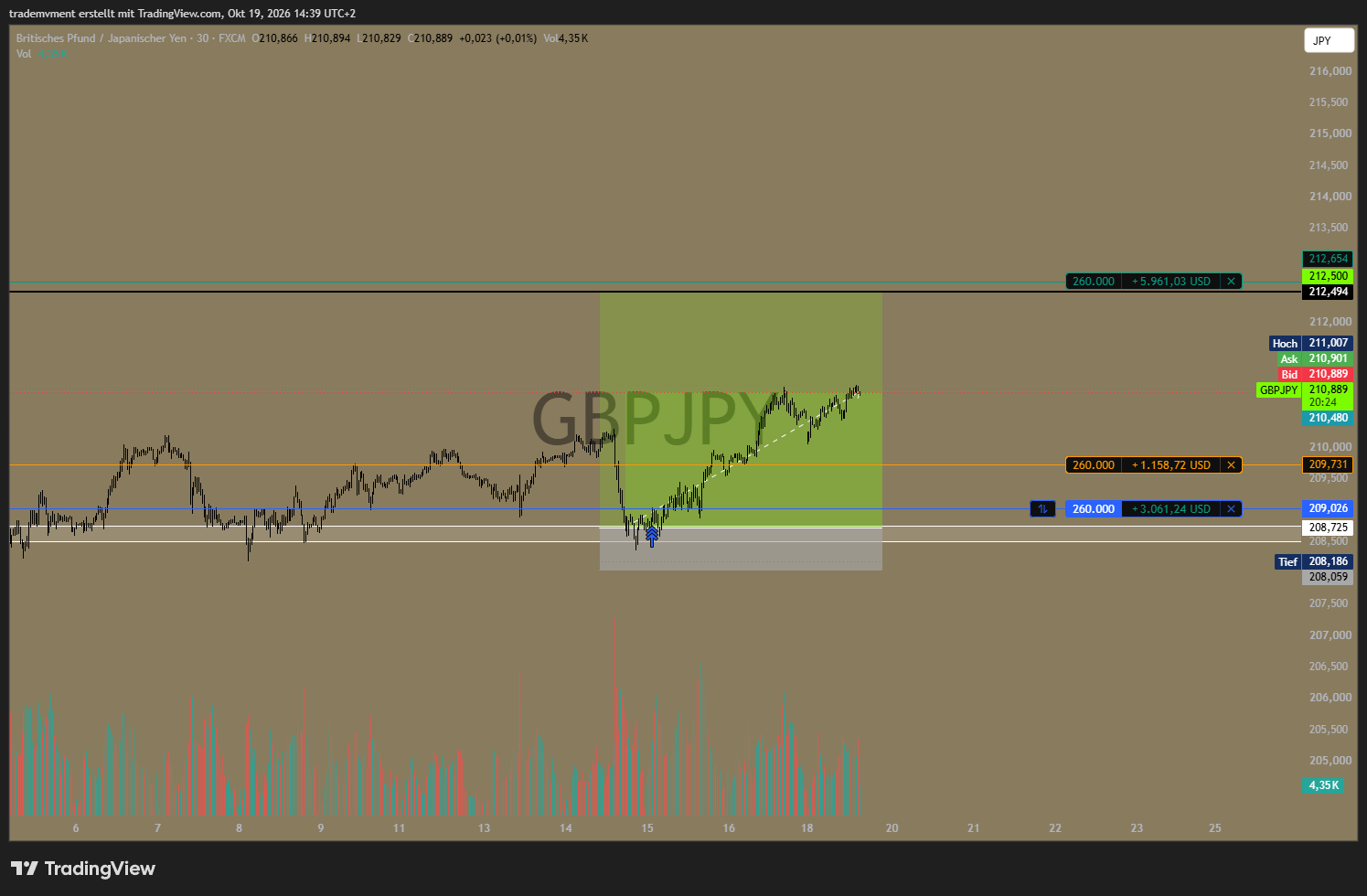
I favour a long position in the marked lower area around JPY 208.50–208.82. The level around JPY 212.50 drawn in the chart serves as my initial reference for a recovery.
My expectation is that the pound regains strength while the recent yen recovery fades. For this, I combine the seasonal window, Commercial accumulation and the pound's resilience with the changed positioning picture in the yen.
A sustained break of the lower GBP/JPY zone or a strong yen appreciation caused by faster BoJ tightening or a carry unwind would argue against this scenario.
My bias therefore remains long for the October/November window.
Data basis: Price and indicator images from 8 October 2026; COT Legacy, futures-only, reporting date 29 September 2026. The economic assessment takes account of data released through 8 October 2026.
Source review · 17 October 2026
Links reviewed on 17 October 2026. Supplementary source figures were added during this review; the original publication date and TradingView charts are preserved.
Dated updates
Progress update ·
Following · stop at break-even
Position update — 18 October 2026
The GBP/JPY long is still running, with the stop moved to break-even. I have attached the updated TradingView chart and the position screenshot. The original setup and its target remain documented below.
Fundamental update — since the 8 October analysis
The 15 October ONS release showed UK GDP rising 0.1% in August and 0.7% over the latest three months. That reinforces the resilience argument on the GBP side. For this cross, relative UK/Japan rate expectations and renewed demand for the yen remain important; stronger UK activity alone does not settle the outcome.

Progress update ·
Following
Position update — 19 October 2026
The GBP/JPY long remains open. I have trailed the stop further and am now simply letting the position run. The updated TradingView chart is attached below.
Loading comments…